
I have sat through countless presentations like this, and they all follow the same pattern.
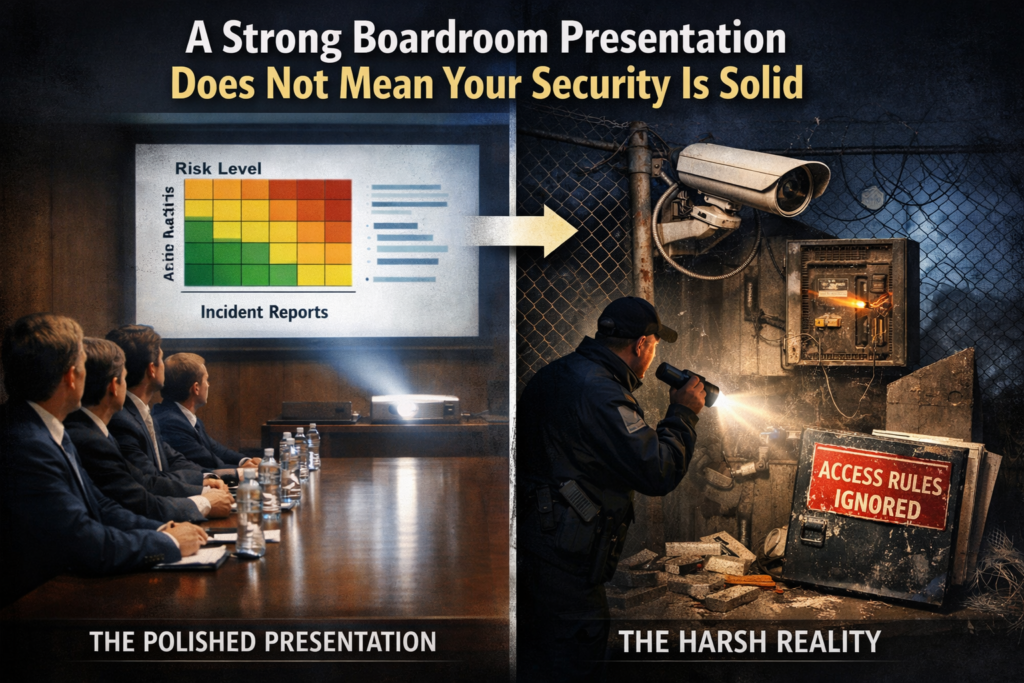
Independent security risk assessment – A long-polished table, bottled water lined up neatly, and a projector humming in the corner as if clearing its throat. The lights dim and the slideshow begins. Risk matrices, heat maps, bullet points, and a timeline squeezed into twelve slides, most likely prepared late on a Sunday night.
I lean back and watch. Over more than twenty years, I have seen this play out in residential estates, hospitals, corporate offices, and factories. Different logos on the walls, but always the same script. Security presented as theater.
The facilities manager highlights access control.
The service provider promotes response times. Someone points to a graph showing fewer incidents. Heads nod, pens move, and coffee cools. From the outside, everything looks controlled and professional.
What they miss is simple and dangerous. Fewer than one percent of the people around that table have truly walked their property. Not a quick escorted tour. They have not stood at the perimeter fence at night, watched a shift change, followed a visitor from reception to the back of the building, tested panic buttons, or checked whether radios actually work when pressure hits. They know security from slides, not from reality.
That is where problems begin.
A few months after one such polished presentation, my phone rang. The voice was calm but tight, the kind of calm people force when panic sits just below the surface. There had been an incident. A breach, a theft, a close call, sometimes something far worse. The question was always the same. How could this happen after such a positive presentation?
We did not go back to the boardroom. We went to the site. That is where reality waits. Cameras pointed at trees instead of doors. Access cards shared between staff. Standard operating procedures (SOPs) sitting untouched in binders for years. Security officers are improvising because training disappeared when a previous contractor left. Lights not working in critical areas. Blind spots are slowly expanding. Visitor rules that existed only on paper.
None of this appeared on the slides. This is what false security looks like. It shines on paper and leaks risk everywhere else.
At Alwinco, we see this repeatedly. Organizations believe they are safe because policies are written and contracts are signed. But security is not procurement. It is a living system, and it decays when leadership stays distant.
One of the most telling moments I have seen did not happen on a site but in a courtroom. The CEO was on the stand, not the facilities manager and not the service provider. The questions were direct. How are officers trained? What is the escalation process? When were the SOPs last reviewed? How is shift fatigue managed?
The answers drifted back to reports and assurances. Our provider says. According to our documentation. It was not enough. The court expected knowledge, oversight, and accountability. He could not explain his own procedures, not because he did not care, but because he had never been close enough to truly know them.
The gap between the boardroom and the site was impossible to ignore.
In that moment, responsibility becomes very clear. Security does not belong to reports or providers. It belongs to leadership.
This is where independent security risk assessment matters. They return real control to the people who are accountable for decisions.
Internal checks filter information upward. Provider assessments are shaped by the need to retain contracts. Independence cuts through both. At Alwinco, we do not sell cameras, offer security officers/guards, or do installations. We observe, assess, and report what is actually happening.
That independence changes the conversation. It shifts focus from budgets to exposure, from appearance to action.
Our assessments translate operations into clarity for executives. We map intruder routes, identify insider risks, expose procedural breakdowns, and measure real response times. Security becomes strategic rather than purely technical.
Boards start seeing causes instead of symptoms.
Systemic flaws, behavioral patterns, and long-standing neglect become visible. Decisions are made on evidence, not reassurance.
There is also a legal reality. Courts assess due diligence, not just the presence of security measures. An independent assessment shows that unbiased expertise was sought, risks were identified, and corrective action followed. It documents governance, intent, and accountability.
When something goes wrong, that record matters. It draws a clear line between an incident and negligence. You did not rely on assurances. You demanded the truth and acted on it.
Independence does not remove responsibility. It strengthens it through visibility and defensible decisions in an environment where assumptions carry heavy consequences.
One of the most persistent myths is that security can be fully delegated. Appoint a provider, approve a budget, receive updates, and move on. Crime does not respect organizational charts. It looks for gaps, and distance creates them.
We have seen standards quietly slip.
Advice softened, cheaper options accepted, warning signs ignored. Small compromises accumulate until the system fails and a breach happens.
Walk your property yourself. Watch the gate during peak traffic. Observe visitor movement. Check lighting at night. Test radios during live operations. It is behavioral, not paperwork.
Effective security comes from leaders who are present, who observe, and who ask difficult questions. They treat security as governance, not a line item.
After more than twenty years and hundreds of assessments at Alwinco, the pattern is clear. Distance creates assumptions. Assumptions create blind spots. Blind spots create risk, and risk attracts crime.
When boards understand security only through presentations, they are managing a story instead of a system. Stories do not stop criminals. Presence does.
Article Written By Andre Mundell.
Disclaimer: Images in this article are AI-generated. The content, analysis, and insights are entirely human-written and reflect our independent expertise.
Understanding Security Risks, the Role of Independent Security Risk Assessors, and Security Managers