
Security has changed
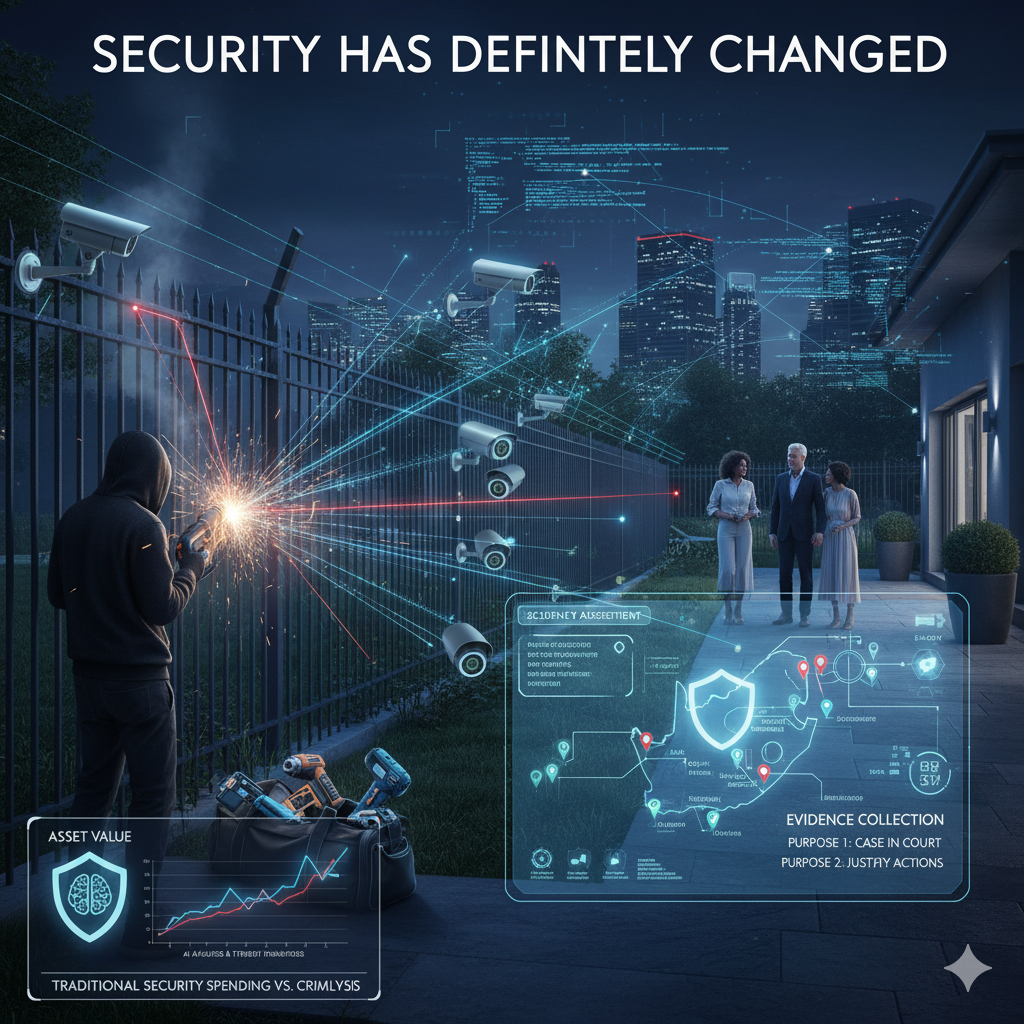
Security risk assessment – Security has changed noticeably in the past five years and continues to change as we speak. Physical security and hard barriers no longer provide the certainty they once did. With the technology available today, such as wireless cutting tools and power tools that run on batteries or hydraulics, almost anything made by human hands can be cut open. These tools are small enough to fit into a sports bag or backpack, which makes them even more effective.
This shift has changed how we must approach security.
People with criminal intentions now have access to advanced communication tools. They are often able to communicate more effectively than the average homeowner, state institution, or even many corporate companies. They have a stronger sense of communication, for lack of a better term, and a stronger desire to communicate when pursuing their end goal.
What I am trying to explain is that the average person with criminal intentions has a greater will to succeed than the average homeowner, estate, or business that must stop them. One side is fully committed to reaching the goal, while the other often hesitates because of cost concerns or because they unknowingly place a limited value on human life.
Most people, when asked about the real value of their assets, cannot answer. They have never taken the time to work it out or do not have a model to calculate true asset value. The real questions are simple. What are we protecting? How do we protect it? And what is the true value of that protection? Years ago, we asked how security should be measured and what the value of security really is.
A version of these same questions is still raised every time I attend a conference.
How do you measure security, and how do you calculate its value? The real answer is that you measure security through a risk assessment. A security risk assessment is a complete investigation of your security portfolio that identifies the risks that lead to crime. The value of security is more complex. Before you can understand the value of security, you must understand the value of the asset, and that process is far more involved.
What I am trying to explain to people is that security has changed.
We are operating in an entirely different environment. Many still try to rely on old methods, and they are losing ground because those methods are no longer effective or relevant.
Then we have our friend AI. On one hand, it supports security by helping us make faster decisions and by identifying criminal intention or suspicious individuals, which gives us additional time to act. On the other hand, AI challenges us in court cases, which brings us back to the question of how evidence is collected.
This is one of the most significant changes in the security system.
Everything now depends on how you collect evidence. If you face criminal intention or become part of a crime scene, you must be able to show clear and credible evidence to the court.
In South Africa, you must also justify why certain actions were necessary. You need to show why you protect your life and why specific security measures are required, because no one else will do that for you. It is becoming more difficult, which means your evidence collection needs to serve two purposes.
One purpose is to prove your case in court, and the other is to justify why you took a specific action. In simple terms, you must be able to show the court how the criminals acted, how they broke in, and what their intentions were. At the same time, you must show that the steps you took to protect yourself, your family, and your assets were necessary because of the level of violence involved.
Evidence has become a twofold requirement.
Everything eventually comes back to the concept of a master copy. There are already court cases that state that if the master copy is not available, the court cannot confirm whether the evidence presented has been altered. Without a master copy, there is no way for the court to trust what is in front of them. This is the reality we are facing.
Security is not rocket science, but there are certain elements that must be in place. Every security portfolio has essential functions, whether it is a house, an estate, a corporate company, a state-owned company, or a large business. The type of property does not change these requirements.
These functions should be present in every security setup, yet in most cases they are missing.
Management often fails to do what is needed. Communication is weak, instructions are unclear, and evidence collection is handled poorly.
Knowing how your system works is often a problem. Understanding what to do next is a problem. Especially at home, knowing when security needs to shift from alert to active protection is a challenge. Modern security has many small but critical gaps, and these often go unnoticed.
Many people still believe that simply installing a camera equals security.
That is not true. Where does the camera feed go? How will you act on the information it provides? These are the questions a security risk assessment addresses. In a security risk assessment, we take you beyond the old system, provide clarity, and guide you on how to adapt to the demands of the new security environment.
What I do not understand is why people in South Africa are so reluctant to learn about and understand their security. If you follow the news, it is clear that we are losing the war against crime. Even though the private sector spent R60 billion on security last year, we are still struggling to contain crime.
This illustrates a critical point:
Spending heavily on security does not guarantee protection. If R60 billion in a single year does not stop crime, something is fundamentally wrong. A security risk assessment can explain why, but there is no single solution that fits every situation.
That is why an independent security risk assessment is essential. It investigates the risks, identifies the threats, and provides the answers you need. It comes back to our motto: you cannot reason with crime. That is a principle you must always keep in mind.
Prevention is always better. Yet, in the last 40 years of working in security, I still do not understand why wisdom often comes only after a disaster. Why do people not gain the insight beforehand to prevent crime? Part of the reason lies in the way insurance works. Many believe they can replace material losses, thinking it is enough to ensure that no life is lost during a crime.
If no one’s life is threatened, the loss of equipment or assets can be replaced.
In that sense, it may seem acceptable. But that one moment, one millisecond, when the wrong people are involved and lives are at risk, can turn a single crime into a disaster.
The threat goes beyond physical harm. Criminals gaining access to confidential documents, photos of your children, family addresses, school information, contracts, banking details, and other personal data can create consequences that last long after the initial crime. Much of this information is stored on computers and laptops, often including passwords, making it highly vulnerable.
The risk is even greater for residential estates, corporate companies, doctors, and schools that hold sensitive data about clients, members, parents, and children. Access to this information can lead to identity theft, financial fraud, blackmail, or further attacks, causing ongoing damage far beyond the original breach.
All of this highlights a critical point: once a crime occurs, evidence is often incomplete or lost.
Many people in South Africa who have experienced major crimes did not have the necessary proof because they failed to collect it. Without proper evidence, it becomes nearly impossible to respond, recover, or hold the perpetrators accountable. Understanding these risks and collecting evidence proactively is essential to effective security.
That is one area where we consistently fail. We cannot present the right evidence and proof in court. Today, with well-designed systems, such tasks should be easy to do.
The key is understanding your risk. # Security risk assessment
Please note we use AI generated images.